핵심 요약
이 논문은 patch-based monocular SLAM의 online 최적화와 feed-forward reconstruction model의 dense depth / moving-object prior를 결합해, 동적 장면에서 pose와 scale-consistent depth를 함께 안정화하는 시스템을 제안한다.
핵심은 π3mos가 제공하는 moving mask와 depth prior를 DPV-SLAM식 sliding-window BA에 넣되, scale alignment와 uncertainty-aware weighting으로 feed-forward model의 batch scale ambiguity를 보정하는 것이다.
π³mos
feed-forward reconstruction model에 MOS head를 추가해 moving object mask, depth, confidence, camera pose를 함께 예측.
Hybrid SLAM
dense prior를 그대로 믿지 않고 patch-based BA의 geometric constraint와 결합.
Scale Alignment
batch-wise feed-forward inference에서 생기는 scale ambiguity를 historical keyframe patch depth로 정렬.
Uncertainty-aware BA
depth prior가 필요한 frame에서는 강하게, BA만으로 충분한 frame에서는 약하게 작동하도록 weight 조절.
이 논문은 dynamic SLAM을 masking 문제로만 보지 않는다. feed-forward model이 잘하는 dense prior와 SLAM이 잘하는 incremental optimization을 서로 보정하게 만드는 구조가 핵심이다.
온라인 최적화가 강함
sliding-window BA와 patch tracking으로 pose를 안정적으로 갱신하지만, 동적 객체와 monocular scale/depth uncertainty에 취약.
dense geometry prior가 강함
multi-view 학습 prior로 depth와 mask를 잘 예측하지만, batch-wise 사용 시 scale consistency와 online drift가 문제.
상호 보정 구조
mask/depth prior가 BA를 돕고, BA의 patch scale이 feed-forward depth를 다시 맞춤.
논문 상세 정리
이하에서는 배경지식, notation, 보조 유도까지 포함해 논문의 세부 내용을 살펴본다.
Problem: dynamic SLAM에 왜 general 3D prior가 필요한가
초록의 핵심은 동적 장면에서 camera pose와 3D reconstruction이 흔들리는 이유를 moving object와 monocular depth/scale uncertainty로 보고, 이를 patch-based BA와 feed-forward reconstruction prior의 결합으로 해결하겠다는 것이다.
두 계열의 장점을 단순히 나란히 붙이는 것이 아니라, BA와 learned prior가 서로 보완하도록 설계한다.
| 문제 | 사용한 prior | SLAM에서의 역할 |
|---|---|---|
| Moving object | π3mos의 motion probability | static patch만 골라 잘못된 correspondence 축소 |
| Monocular scale | dense depth prediction | historical patch depth와 scale 정렬 |
| Depth uncertainty | patch depth covariance | depth prior loss weight를 frame별로 조절 |
Context: dynamic object와 monocular ambiguity가 왜 어려운가
Introduction은 기존 VO/SLAM이 정적 환경 가정에 묶여 있고, moving object가 data association과 map quality를 무너뜨린다는 문제에서 출발한다. 반대로 feed-forward reconstruction model은 dense geometry prior가 강하지만, online long sequence에서는 memory, latency, drift, scale consistency 문제가 남는다.
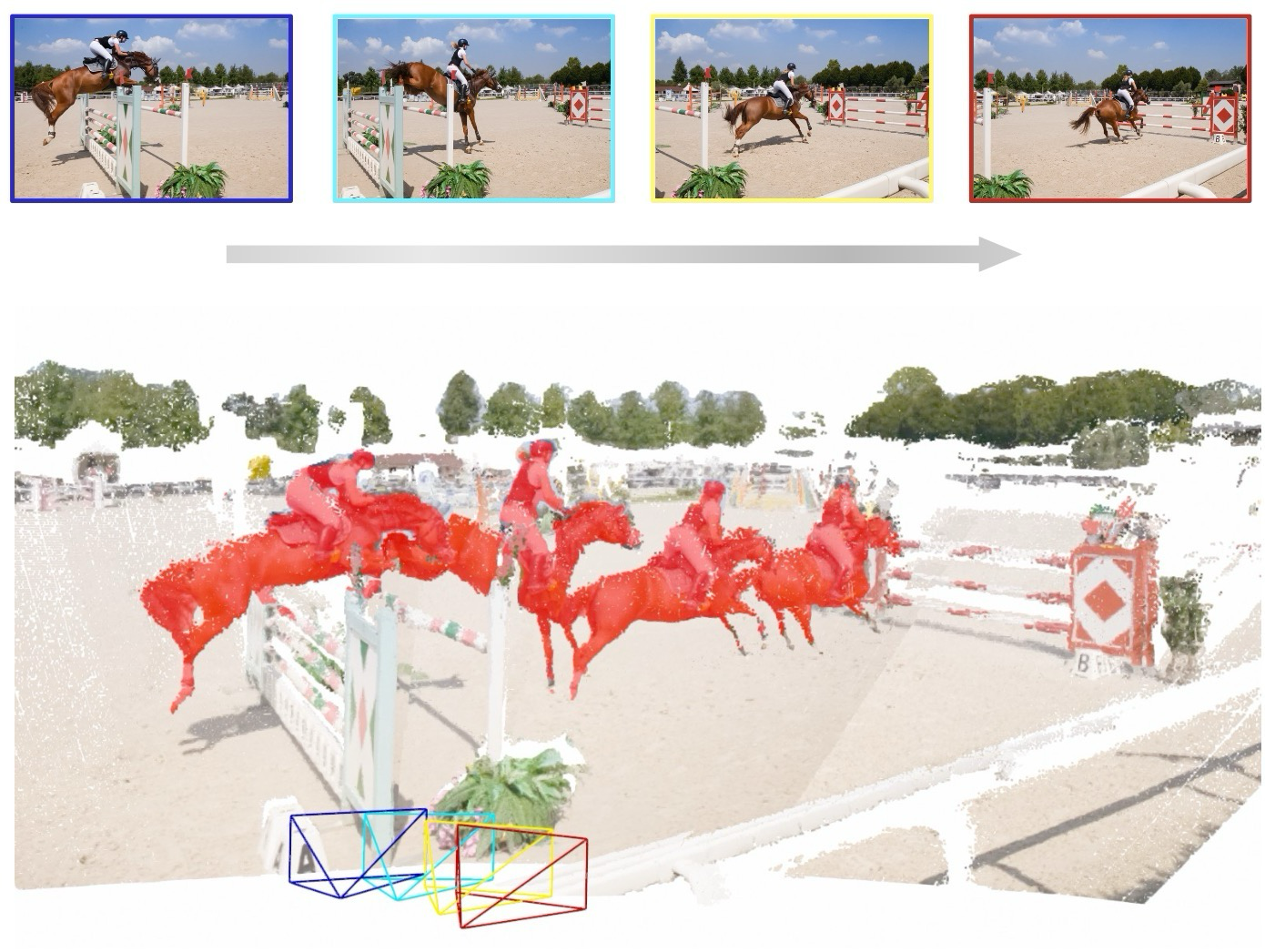
논문은 “SLAM은 online이 강하고, feed-forward model은 prior가 강하다”는 대비를 만든 뒤 둘을 결합한다.
| 축 | 한계 | 논문의 연결 방식 |
|---|---|---|
| Classical SLAM | static assumption, sparse reconstruction, monocular depth ambiguity | BA backbone으로 online consistency 유지 |
| Feed-forward model | batch inference, scale ambiguity, long sequence drift | moving mask와 depth prior만 SLAM에 주입 |
| Hybrid result | 각각 혼자서는 dynamic long sequence가 어려움 | mask, scale, uncertainty를 BA 안에서 조절 |
Gap: SLAM과 feed-forward 3D prior 사이에 무엇이 비어 있나
Related Work는 두 흐름을 대비한다. 하나는 moving object를 explicit하게 제거하려는 dynamic SLAM 계열이고, 다른 하나는 dense geometry를 바로 예측하는 feed-forward reconstruction 계열이다.
Related Work 흐름
세부 문헌명보다 각 계열이 왜 이 논문의 필요성을 만드는지 보는 것이 중요하다.
DynaSLAM처럼 known dynamic class나 segmentation network에 의존.
multi-frame point trajectory로 static/dynamic을 구분하지만 offline mask나 긴 관측에 의존.
VGGT, π3처럼 dense structure와 pose를 빠르게 예측하지만 online 적용에 제약.
CUT3R류는 memory를 쓰지만 long sequence drift가 남음.
논문의 문제의식은 dynamic mask와 feed-forward prior가 각각 강하지만, 단독으로는 online SLAM의 안정성을 보장하기 어렵다는 데 있다.
| 흐름 | 강점 | 남는 빈틈 |
|---|---|---|
| Mask / detector SLAM | 움직일 가능성이 큰 영역을 명확히 제거 | unknown dynamic, segmentation failure, static-but-movable object에 취약 |
| Trajectory dynamics | multi-frame consistency로 실제 움직임을 판단 | 긴 window나 offline processing이 필요한 경우가 많음 |
| Feed-forward 3D prior | depth, pose, dense geometry를 빠르게 제공 | scale, temporal consistency, backend integration이 별도 필요 |
| 이 논문 | prior를 SLAM 내부의 초기값/weight/constraint로 사용 | 학습된 3D prior를 optimization 흐름으로 흡수 |
Mechanism: 3D prior를 SLAM objective에 어떻게 넣나
Approach는 DPV-SLAM을 기반으로 하되, π3mos가 예측한 motion probability, dense depth, confidence를 sliding-window BA에 넣는 방식으로 구성된다. 목적은 pose Ti ∈ SE(3)와 scale-consistent depth map Di를 online으로 추정하는 것이다.
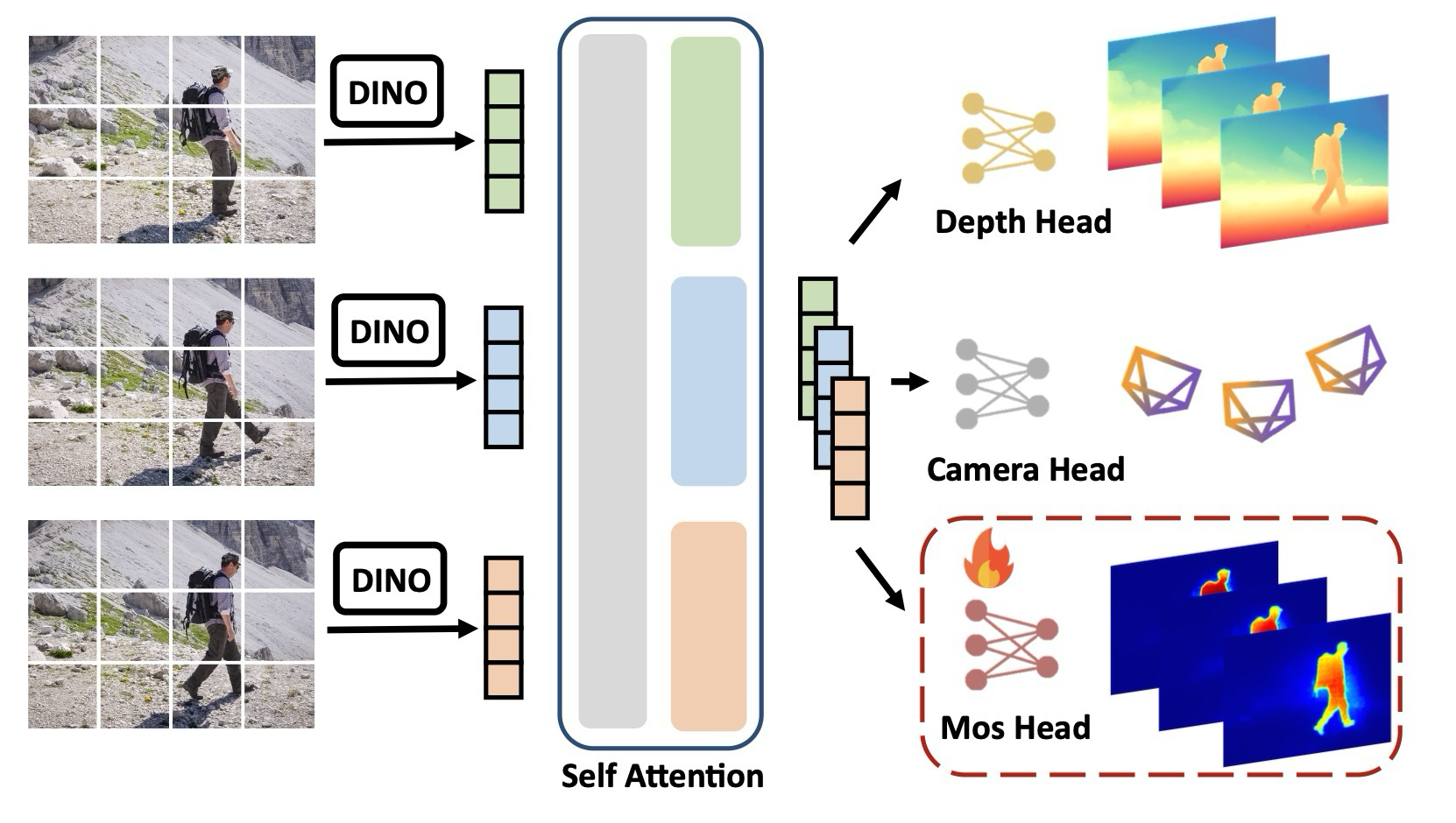
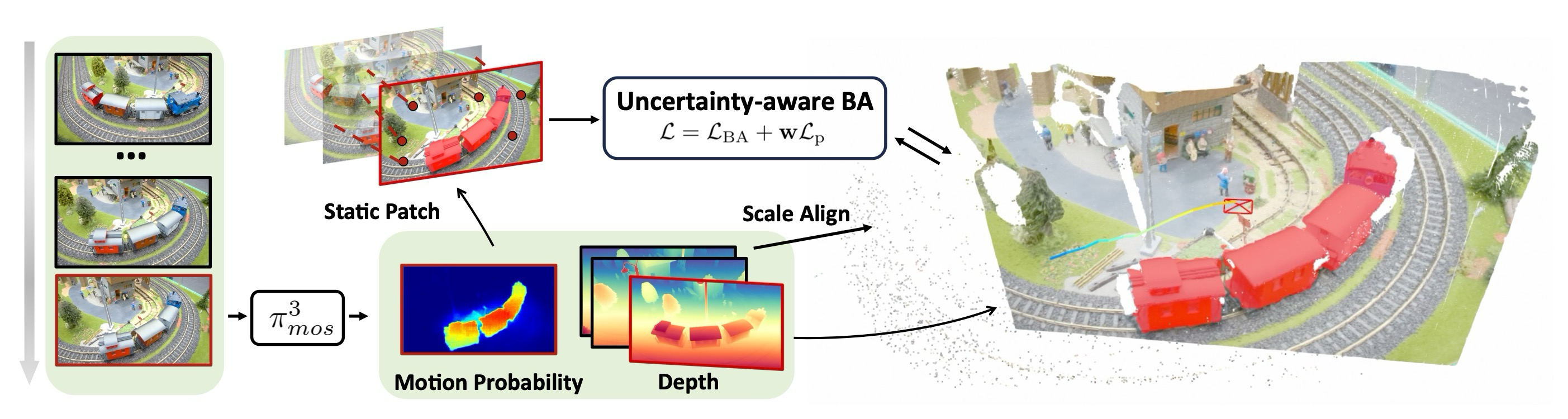
각 모듈은 독립적인 성능 향상 장치가 아니라, 다음 단계의 실패 모드를 줄이기 위해 배치된다.
| 구성 | 담당 | 왜 필요한가 |
|---|---|---|
| DPV-SLAM | patch tracking + sliding-window BA | online pose/depth consistency 유지 |
| π³mos | motion probability, dense depth, confidence 예측 | 동적 영역 제거와 depth prior 제공 |
| Static patch sampling | Mi < sd 영역에서 patch 선택 | moving object correspondence가 BA에 들어가는 것을 방지 |
| Scale alignment | historical keyframe patch와 predicted depth scale 정렬 | batch-wise prior의 scale ambiguity 보정 |
| Uncertainty-aware BA | depth prior loss의 frame weight 조절 | prior가 도움 될 때만 강하게 사용 |
Mechanism: 핵심 objective와 update는 무엇인가
수식은 DPV-SLAM의 reprojection BA, π3mos prediction, scale alignment, uncertainty-aware depth prior로 나눠 읽으면 된다. 핵심 block 수식은 아래처럼 역할 중심으로 먼저 정리하고, 누락되기 쉬운 보조 수식은 이어지는 보조 수식 정리에서 번호별 역할을 확인할 수 있게 했다.
| 기호 | 의미 |
|---|---|
| \(\mathbf{G},\mathbf{d}\) | camera pose와 patch inverse depth state |
| \(s_f\) | feed-forward depth를 BA scale에 맞추는 frame별 scale factor |
| \(w_f\) | relative depth uncertainty로 정하는 frame별 depth-prior weight |
Mechanism: notation과 보조 수식은 어떻게 연결되나
Schur complement, prior output, depth uncertainty를 이루는 보조 수식을 번호 순서와 역할에 맞춰 이어서 본다.
| 기호 | 의미 |
|---|---|
| \(\mathbf{B},\mathbf{E},\mathbf{C}\) | pose, coupling, inverse-depth Hessian block |
| \(\Sigma_T,\Sigma_{\mathbf d}\) | pose covariance와 inverse-depth marginal covariance |
| \(\sigma^{\mathrm{rel}}_z\) | scene scale에 무관한 relative depth uncertainty |
Evidence: 어떤 dynamic scene에서 검증했나
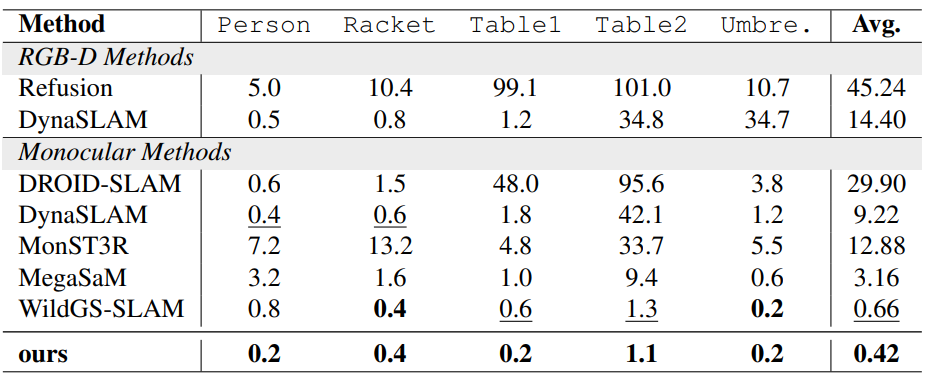
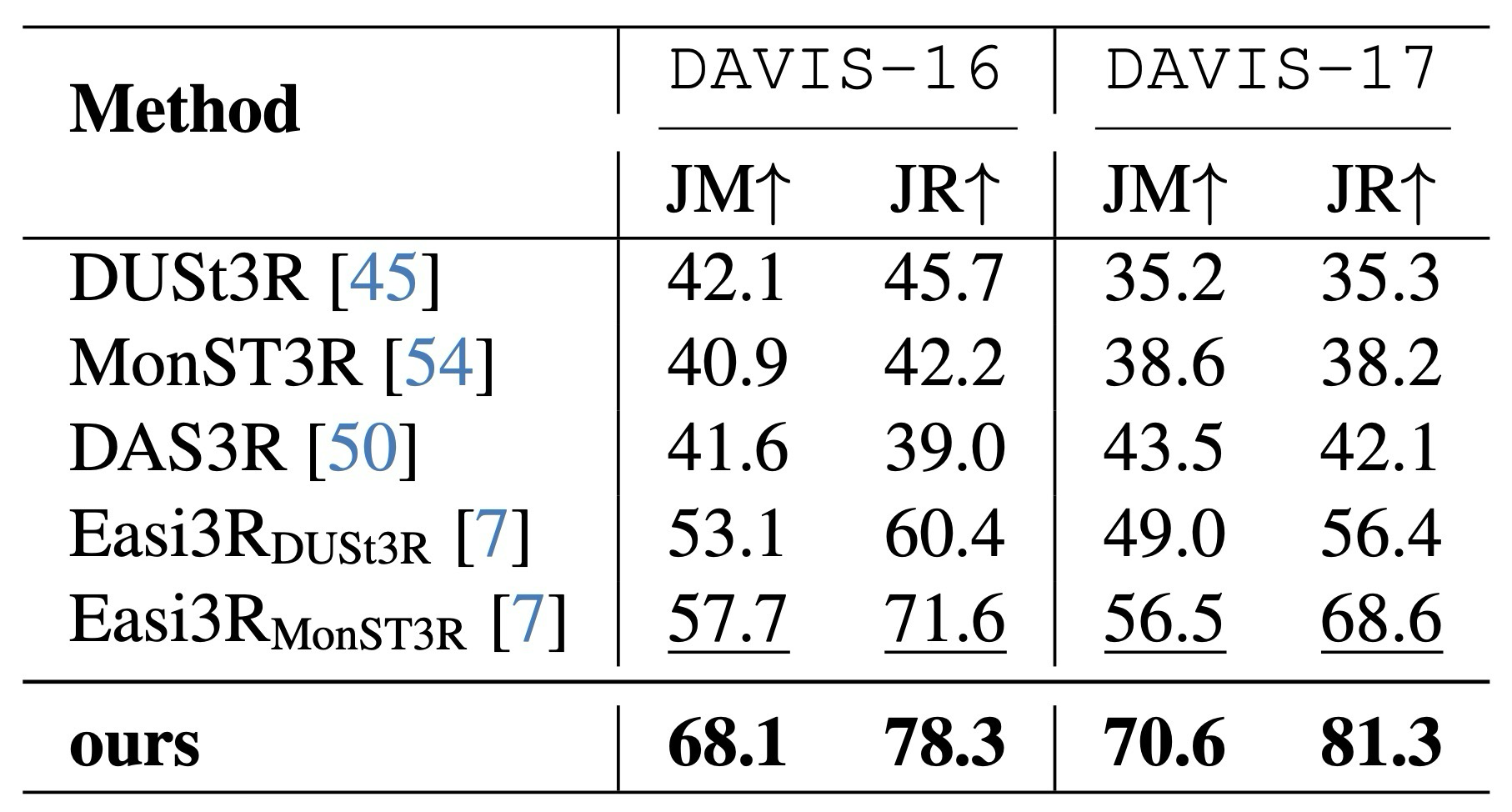
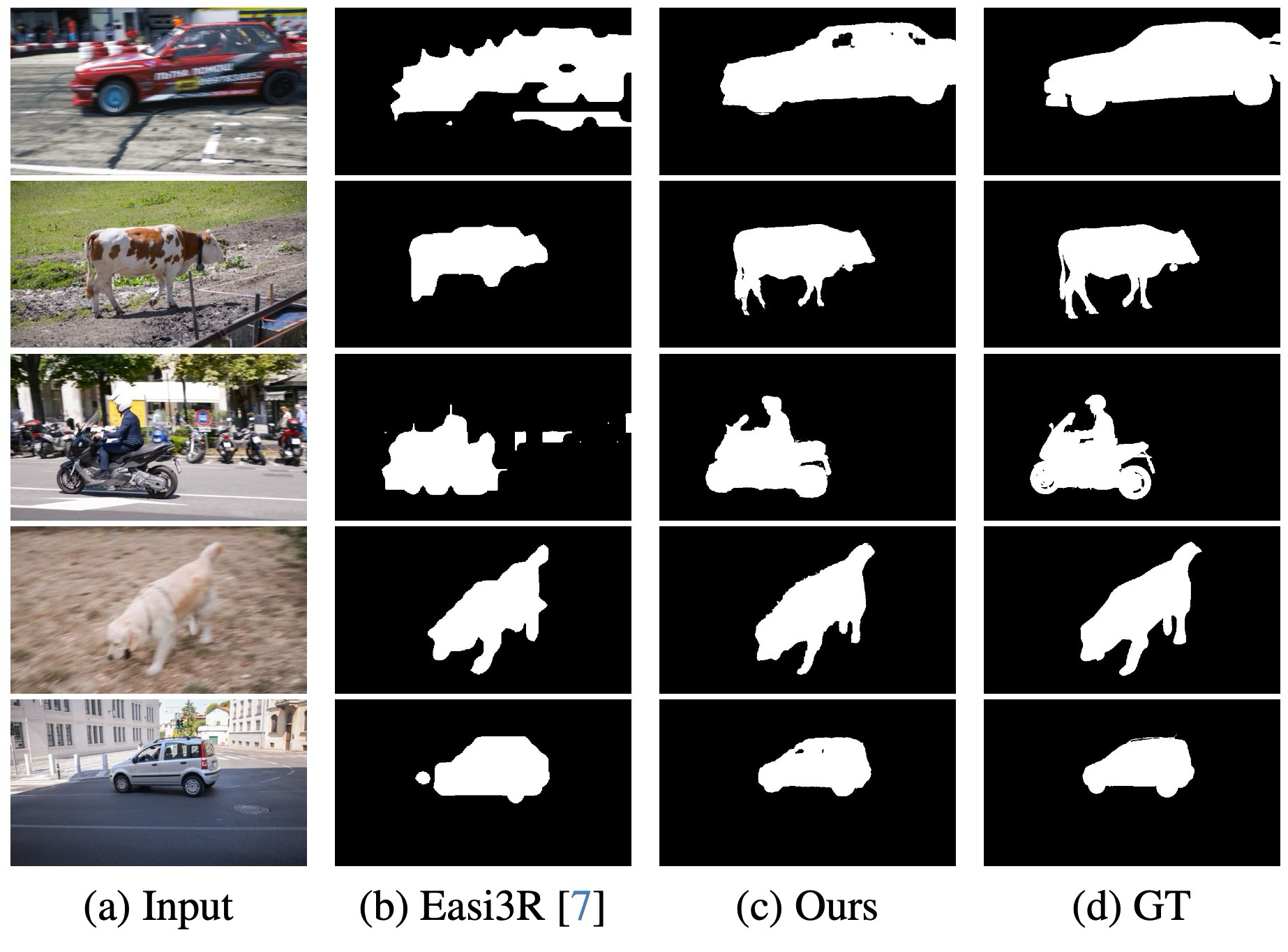
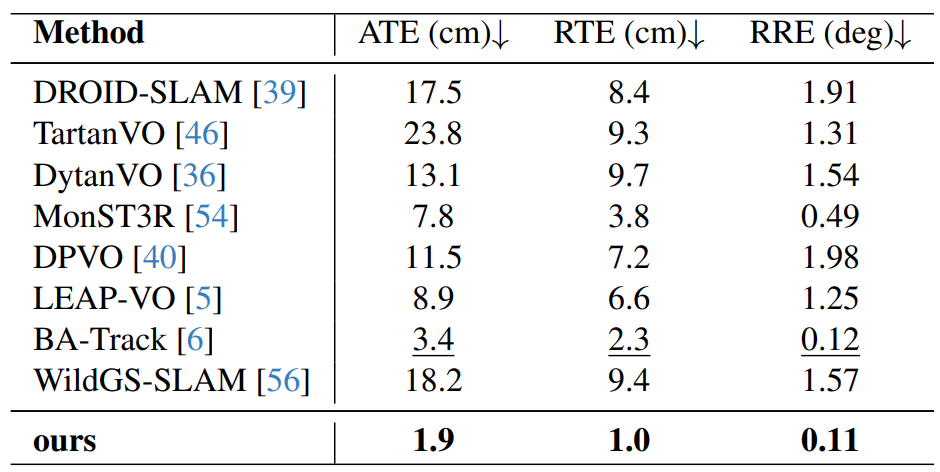
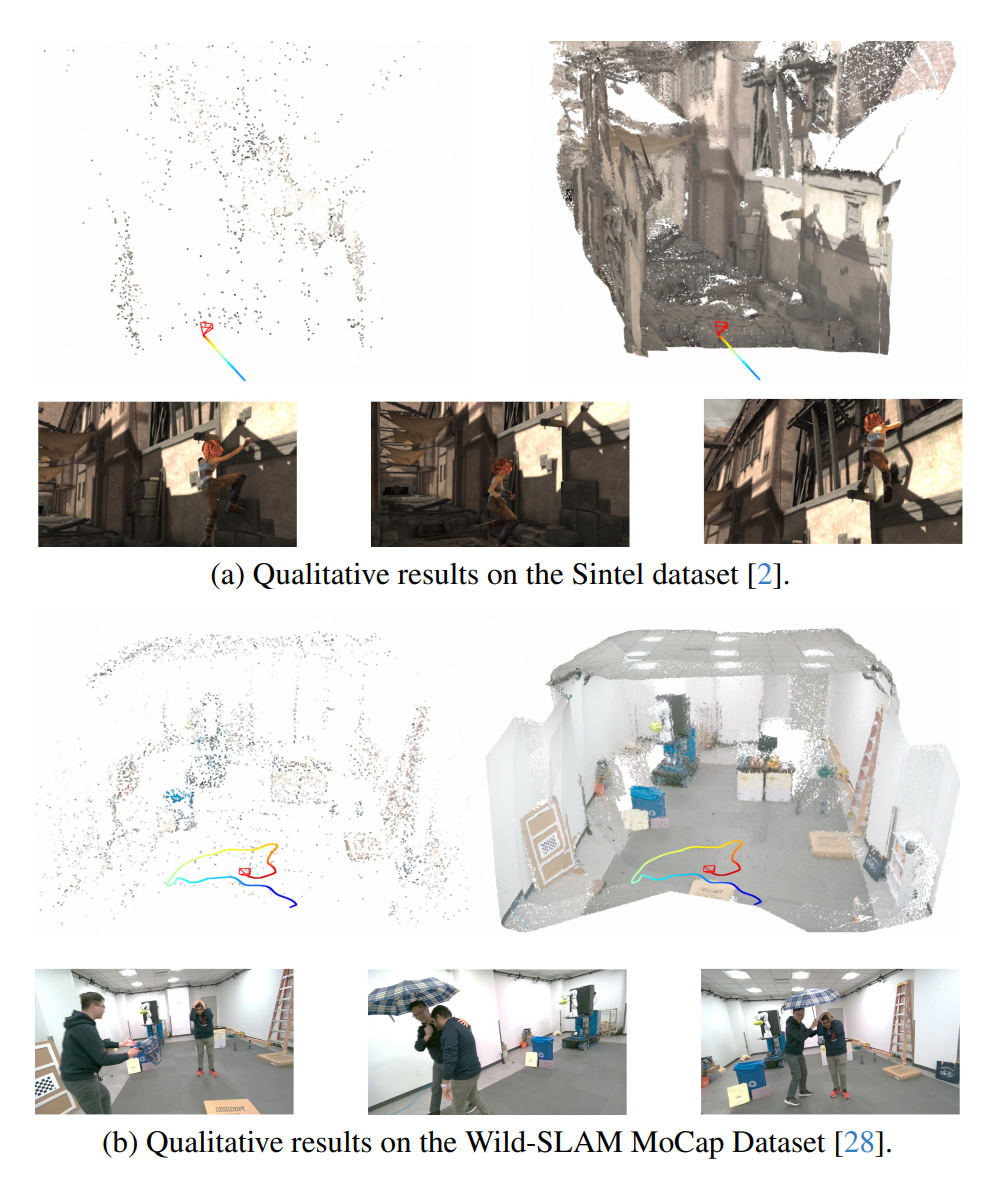
실험은 moving object segmentation, camera tracking, video depth estimation, ablation으로 나뉜다. 논문의 메시지는 π3mos의 mask가 동적 영역을 잘 제거하고, scale-aligned depth prior와 uncertainty-aware BA가 tracking/depth를 동시에 개선한다는 것이다.
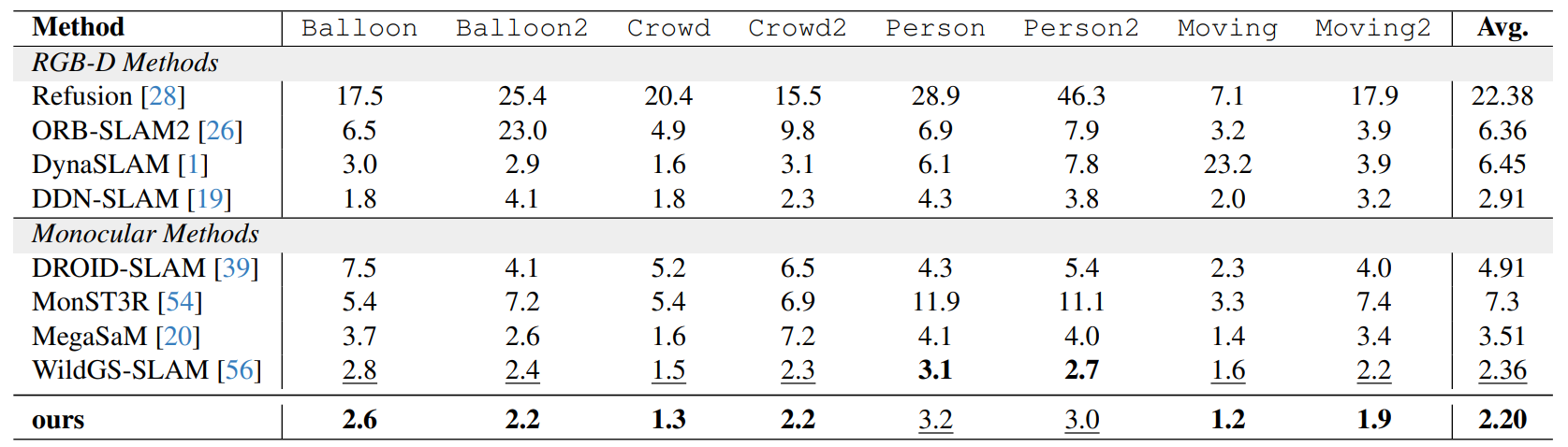
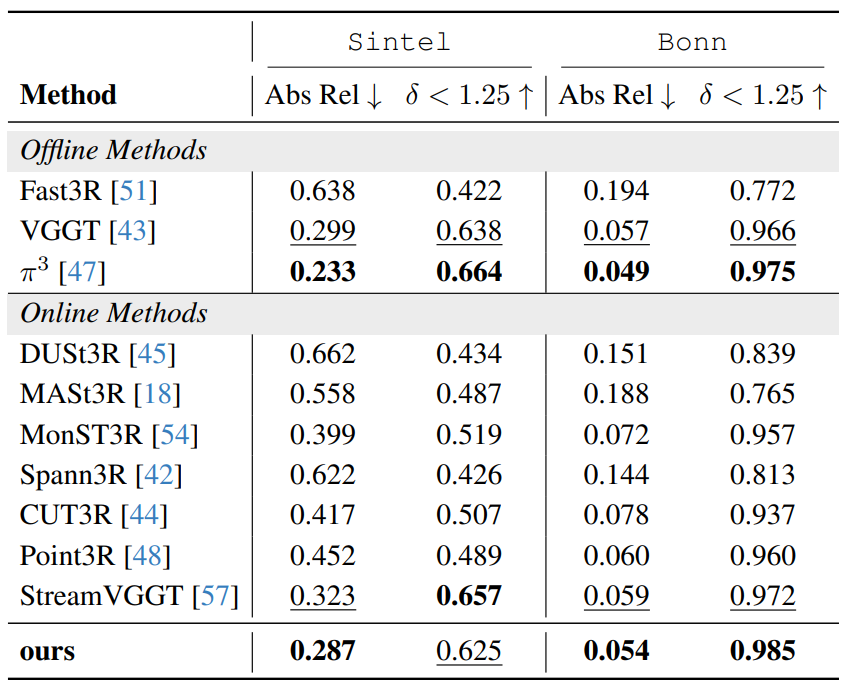
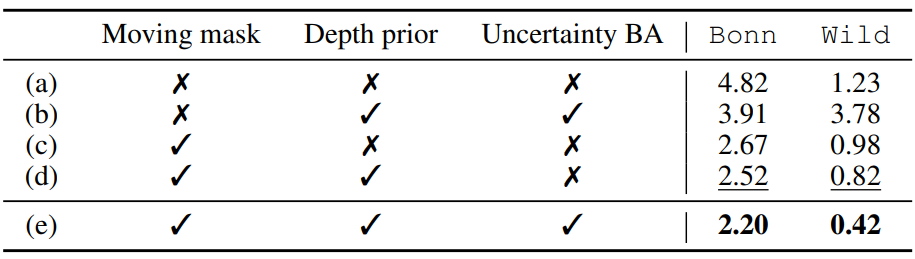
각 table은 서로 다른 claim을 검증한다. Table 3은 mask 품질, Table 1/2/4는 tracking, Table 5는 depth, Table 6은 component contribution이다.
π3mos가 JM/JR 모두 baseline보다 높은 성능.
RGB-D와 monocular baseline 대비 dynamic indoor tracking 개선.
large depth variation, fast motion, blur에서 WildGS-SLAM보다 강함.
online 방법 중 Abs Rel이 낮고 offline π3에 근접.
Moving mask가 가장 큰 축이고, depth prior + uncertainty-aware BA가 추가 개선.
multi-frame inference 때문에 RTX5000에서 약 2 fps.
Usage / Limits: prior-based dynamic SLAM은 언제 유용한가
결론적으로 이 논문은 dynamic monocular visual SLAM에서 feed-forward 3D prior를 후처리로 쓰는 것이 아니라, moving mask, depth prediction, uncertainty-aware depth prior를 patch-based SLAM optimization 안으로 끌어오는 방법을 제안한다. π3mos는 motion probability와 depth를 함께 제공하고, scale alignment와 adaptive weighting을 거쳐 online SLAM의 pose/depth estimation을 안정화한다. 다만 multi-frame prior 추론으로 약 2 fps에 머물고, mask/depth prior의 품질과 batch 간 scale alignment에 성능이 좌우된다.
Problem: why inject a general 3D prior into dynamic SLAM?
The abstract frames the problem as robust pose estimation and 3D reconstruction in dynamic scenes. The proposed answer is a hybrid of patch-based BA and feed-forward reconstruction priors, where moving masks and depth predictions support online SLAM.
The system is not a simple concatenation of modules. The learned prior and BA correct each other's weaknesses.
| Problem | Prior used | Role in SLAM |
|---|---|---|
| Moving objects | Motion probability from π3mos | Samples static patches and reduces bad correspondences. |
| Monocular scale | Dense depth prediction | Aligned with historical patch depths. |
| Depth uncertainty | Patch-depth covariance | Controls frame-wise depth-prior weighting. |
Context: why dynamic objects and monocular ambiguity are hard
The introduction contrasts two weaknesses. Classical VO/SLAM is online and geometrically consistent, but dynamic objects break data association. Feed-forward reconstruction models provide dense geometry priors, but batch-wise online use causes memory, latency, drift, and scale-consistency issues.
The paper links the online strength of SLAM with the prior strength of feed-forward reconstruction.
| Axis | Limitation | Connection in this paper |
|---|---|---|
| Classical SLAM | Static assumption, sparse reconstruction, monocular ambiguity. | Maintains online consistency through BA. |
| Feed-forward model | Batch inference, scale ambiguity, long-sequence drift. | Injects only mask and depth priors into SLAM. |
| Hybrid result | Each side alone struggles with dynamic long sequences. | Handles mask, scale, and uncertainty inside BA. |
Gap: what is missing between SLAM and feed-forward 3D priors?
The related work separates dynamic SLAM methods that explicitly remove moving objects from feed-forward reconstruction methods that directly predict dense geometry and camera pose.
Related Work Details
The important point is how each family motivates this paper's hybrid design.
Relies on known dynamic classes or segmentation networks.
Uses multi-frame point trajectories but often depends on offline masks or long observations.
Predicts dense structure and pose, but online scaling remains hard.
Use memory for sequential inference, but long-sequence drift remains.
The motivation is that dynamic masks and feed-forward priors are both useful, but neither alone guarantees stable online SLAM.
| Line | Strength | Remaining gap |
|---|---|---|
| Mask / detector SLAM | Clearly removes likely dynamic regions. | Fails on unknown dynamics, segmentation errors, and static-but-movable objects. |
| Trajectory dynamics | Uses multi-frame consistency to infer actual motion. | Often needs long windows or offline processing. |
| Feed-forward 3D prior | Provides depth, pose, and dense geometry quickly. | Still needs scale, temporal consistency, and backend integration. |
| This paper | Uses the prior as initialization, weighting, and constraints. | Absorbs learned 3D predictions into the optimization flow. |
Mechanism: how the 3D prior enters the SLAM objective
The method builds on DPV-SLAM and injects motion probability, dense depth, and confidence from π3mos into sliding-window BA. The target outputs are online camera poses Ti ∈ SE(3) and scale-consistent depth maps Di.
Each module is placed to reduce the failure mode of the next stage.
| Component | Role | Why it matters |
|---|---|---|
| DPV-SLAM | Patch tracking and sliding-window BA. | Maintains online pose/depth consistency. |
| π³mos | Predicts motion probability, dense depth, and confidence. | Provides dynamic filtering and depth priors. |
| Static patch sampling | Selects patches from regions. | Prevents moving-object correspondences from entering BA. |
| Scale alignment | Aligns predicted depth with historical patch scale. | Corrects batch-wise prior scale ambiguity. |
| Uncertainty-aware BA | Adapts frame-wise depth-prior weights. | Uses the prior strongly only when it helps. |
Mechanism: what the core objective and update do
The equations divide naturally into reprojection BA, π3mos prediction, scale alignment, and uncertainty-aware depth-prior weighting. The core block equations are summarized first, while the following supporting-equation section keeps the remaining numbered equations visible by role.
| Symbol | Meaning |
|---|---|
| \(\mathbf{G},\mathbf{d}\) | camera-pose and patch inverse-depth state |
| \(s_f\) | frame-wise scale aligning feed-forward depth with BA |
| \(w_f\) | frame-wise depth-prior weight derived from relative uncertainty |
Read each equation by the failure mode it addresses.
| Equations | Role | Reading point |
|---|---|---|
| (1)-(4) | Patch-based BA and Schur complement. | Jointly updates pose and depth in the window. |
| (5) | Defines π3mos outputs. | Predicts T, D, C, M together. |
| (6) | Scale factor estimation. | Historical patch depth calibrates current prior scale. |
| (7)-(9) | Depth-prior loss integration. | Adds dense depth prior into BA. |
| (10)-(14) | Covariance to relative uncertainty to weight. | Adapts the prior weight using uncertainty. |
Formula Notes: how to read notation and auxiliary formulas
This section expands the Schur complement, π3mos output, depth-prior, and covariance equations that were compressed in the Core Equations section.
| Symbol | Meaning |
|---|---|
| \(\mathbf{B},\mathbf{E},\mathbf{C}\) | pose, coupling, and inverse-depth Hessian blocks |
| \(\Sigma_T,\Sigma_{\mathbf d}\) | pose covariance and inverse-depth marginal covariance |
| \(\sigma^{\mathrm{rel}}_z\) | scene-scale-independent relative depth uncertainty |
Eq. (8)-(9) already appear in Core Equations as the final BA + depth-prior objective, so this section continues with covariance and frame-weight auxiliary equations.
Evidence: which dynamic scenes test it?
The experiments cover moving object segmentation, camera tracking, video depth estimation, and ablations. The central message is that the mask improves dynamic filtering, while scale-aligned depth priors and uncertainty-aware BA improve tracking and depth consistency.
Each table tests a different claim: Table 3 for masks, Tables 1/2/4 for tracking, Table 5 for depth, and Table 6 for component contributions.
π3mos achieves the best JM/JR against baselines.
Improves dynamic indoor tracking over RGB-D and monocular baselines.
Handles large depth variation, fast motion, and blur better than WildGS-SLAM.
Best online Abs Rel and close to offline π3 on Bonn.
Moving mask is the largest axis; depth prior and uncertainty-aware BA add further gains.
Multi-frame inference limits the system to about 2 fps on RTX5000.
Usage / Limits: when prior-based dynamic SLAM is useful
The paper proposes a dynamic monocular visual SLAM system that brings a feed-forward 3D prior into SLAM optimization as moving masks, depth predictions, and uncertainty-aware depth priors. π3mos predicts motion probabilities and depths, then scale alignment and adaptive weighting stabilize online pose/depth estimation. Its main limitations are the roughly 2 fps multi-frame prior inference and its dependence on mask/depth quality and batch-to-batch scale alignment.
댓글 남기기